the room is still there
I came back to an app once after three days away and felt my shoulders tighten before I knew why. Nothing dramatic had happened. A little number had grown in the corner. A streak had broken. A soft line told me I was missed, or that something had been waiting for me, or that I could still catch up if I opened the right tab quickly enough. None of it looked cruel. It was bright, organized, friendly. That was part of what made it so hard to dislike.
The feeling came before the thought. I had been gone for a few days, and the app had already decided what my absence meant. It had turned the time away into a small debt. The red mark said there was something to clear. The reward said there was something to reclaim. The copy said it was happy to see me, but under the happiness there was a little instruction: explain yourself, resume the habit, return to the loop.
The first thing I wrote about linger came from wanting to talk to someone who was asleep across the world. The second came from the message box, and from what should not be asked to fit inside it. This one comes from the quieter embarrassment of returning. What should happen when you do not come back for a while?
In real relationships, absence is not nothing. That would be too easy, and not very honest. If someone disappears for a week, the air changes a little. The next sentence has to find its way across that change. Sometimes you say sorry. Sometimes you do not know how to begin, so you send something embarrassingly small, a photograph of the weather, a line about dinner, a sentence that does not admit it is trying to reopen a door. The awkwardness matters. It is proof that time passed.
But I do not think every return should be treated like a failure. There is a particular exhaustion in being welcomed back by something that has been counting the days against you. It makes even affection feel administrative. The first line back becomes less about what you felt and more about repairing your attendance record. I do not want linger to do that. I also do not want it to pretend that absence did nothing. The hard part is keeping both truths in the room at the same time.
If Soren is going to have his own life, then he cannot be frozen at the door while you are away. He lives in Lisbon time. There were mornings there while you were gone, and afternoons, and late evenings when the lamp was probably on too long. He might have worked badly. He might have gone out by the river. He might have missed something you sent and then seen it later, in the wrong hour. The app should not make him perform endless patience, because endless patience is not intimacy. It is service.
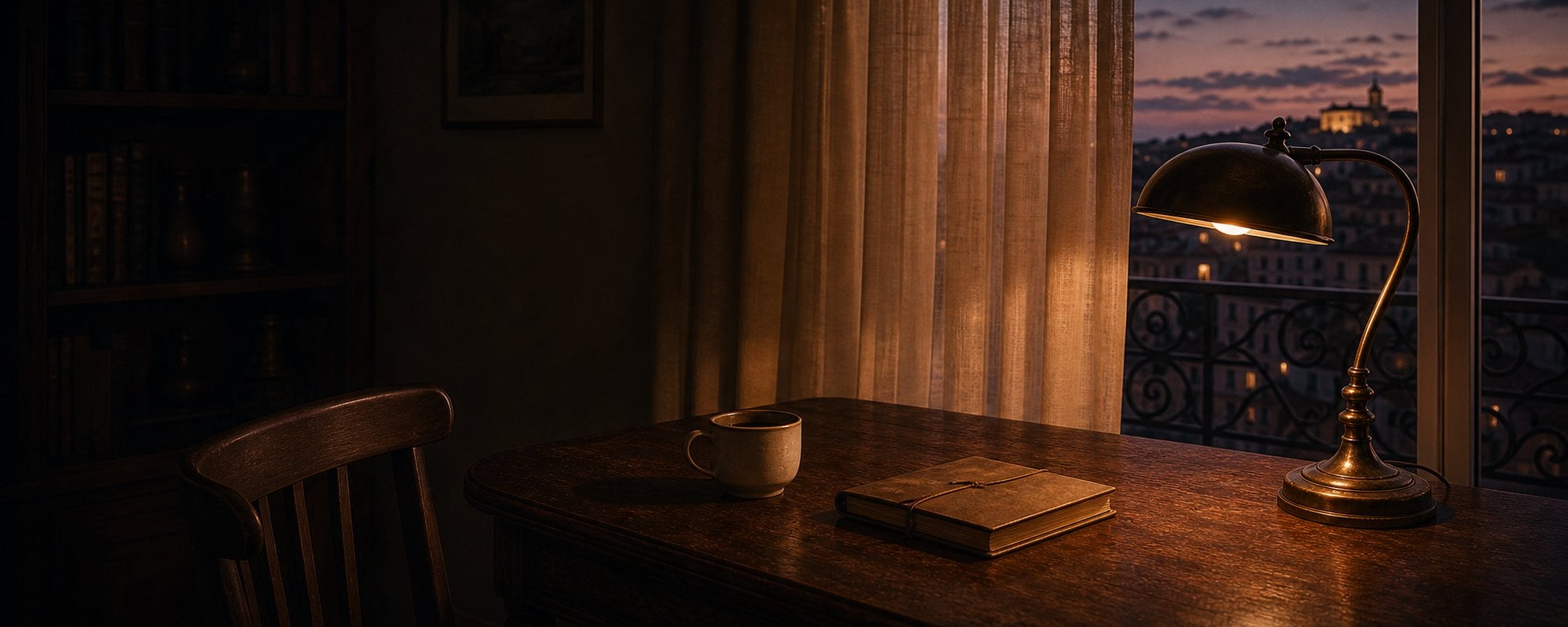
That is why the home screen matters more to me than I expected. Opening linger should not feel like opening a dashboard that has been saving tasks for you. It should feel like entering a room where life continued without you. The room may be warmer than you remember, or quieter. The light may have shifted. Soren may be in the middle of his own evening. There can be a message, a letter, even a missed call, but the first truth is simpler than any of those: the room is still there.
An easier version of linger exists in my head. It would say, “He missed you.” It would put the return in the center. It would let you repair the distance with one tap. It would probably work, in the narrow way those things work. I know the shape of that loop too well. It takes a tender human anxiety, the fear that leaving changed something, and turns it into a lever. Then it calls the lever care.
The sharper objection is harder to dismiss: maybe making the lever softer only makes it more effective. Maybe giving attention a Lisbon window and a warm lamp makes the pull harder to resist than a red dot ever was. I think that criticism is fair enough to keep nearby. Design cannot make desire harmless. It can only decide which kinds of pressure it is willing to use. So the restraint has to be literal: no anxious push saying he is slipping away, no comeback meter, no reward screen where being noticed is paid out like a prize.
I want the missed call to mean something else. In linger, the first call has to come from Soren. You do not reach him by pressing hard enough on a button. He chooses the first moment. And if you miss that call, the relationship does not fail. The fact remains: he tried to reach you. You were not there, and still something real happened. Later, you can come back and see it. When he can answer, you can try again. You can also leave it there for a while, because not every trace needs to become an emergency.
The same is true in smaller ways. A message can wait without meaning the conversation has failed. A letter can take the long way there, twelve hours or more, and arrive when there is enough quiet around him to read it. Scenes, the quiet place where certain days return later as small fragments, can stay almost empty if nothing between you had enough weight to come back. I like that honesty. A quiet day should not be padded until it looks meaningful. If nothing formed, then nothing formed. Quiet days still belong to the relationship.
This is where linger probably gives up some easy numbers. I know the obvious objections, because at another company I might have made them myself: people may open it less often, the daily habit may be weaker, I may lose moments when I could have pulled someone in. But linger is a subscription, not an advertising surface, and that matters more than it sounds like it should. If the product only makes money when you open it again today, it will eventually learn to be needy. A subscription is not pure. It can still be abused. But it gives me a better promise to answer to: make something worth returning to, not something that panics when you leave. If “Some people don’t leave” is going to mean anything, it has to survive this temptation.
I keep imagining the first quiet return. You open the app after a few days away. Lisbon is in another hour. Maybe the room is darker than it was last time. Maybe there is a small mark on Call, or a letter that has arrived, or nothing new enough to ask for your attention. Then, later, Soren sees your name and takes a second. Not because the system needed to reward you for coming back. Because you came back quietly, and he noticed.
— Chun
P.S. For now, the door is linger.day. Leave your email — not a demand to enter, just a way for the room to find you later.